
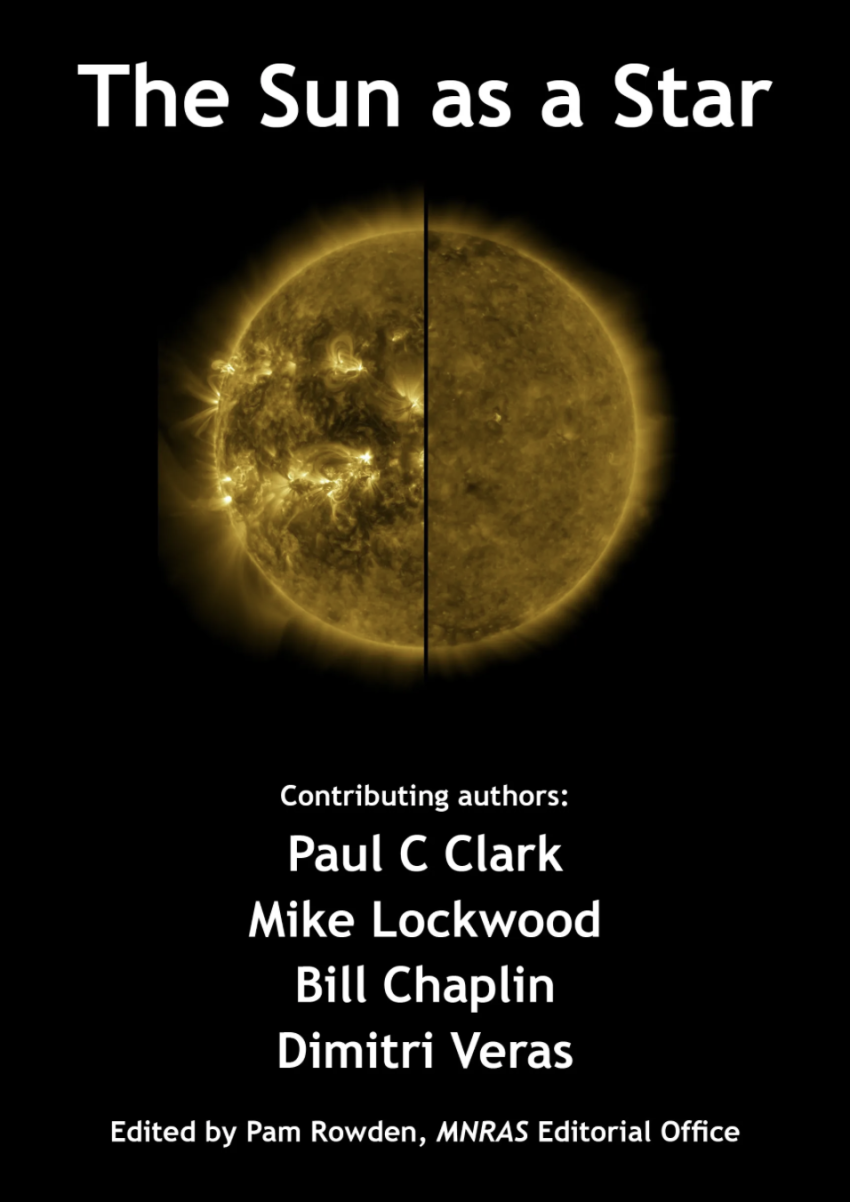

Our growing understanding of the Sun over the past two centuries has been reflected in a new online collection of papers collated from Monthly Notices of the Royal Astronomical Society (MNRAS).
These advancements include the Sun's effect on the planets that orbit it, through the solar wind and coronal mass ejections; its interior, through the growing field of helioseismology; how the Sun – and the Solar System – formed; and what its eventual fate will be.
In celebration of this, the Royal Astronomical Society (RAS) invited four experts to highlight significant papers about the Sun published in MNRAS in their respective fields.
The result is 'The Sun as a Star', a 32-page booklet which has been edited by Dr Pam Rowden from the MNRAS Editorial Office.
First, Professor Paul C Clark explores the formation of the Sun and the Solar System, including the question of how the formation of a single star – rather than a multiple system – may occur.
Former RAS President Professor Mike Lockwood then takes readers on a journey through 12 papers – from the Carrington event of 1859 onwards – concerning observations of the surface of the Sun and the Sun's effect on the Earth (and other planets).
These papers include work on sunspots by heliographic latitude, the famous 'Butterfly Diagram' published by Annie and Edward Maunder, as well as more recent work on the magnetic fields in the inner heliosphere.
In addition, Professor Bill Chaplin explores the growing science of helioseismology, highlighting in particular the work of the Birmingham Solar-Oscillations Network (BiSON). Helioseismology allows us to 'see' beneath the Sun's surface and, through the related field of asteroseismology, aids in our understanding of other stars.
Finally, Dimitri Veras, who last year was awarded the RAS' prestigious George Darwin Lectureship, explores the distant future of our Solar System, considering both the period before and the period after the Sun leaves the main sequence.
The Sun as a Star is available to view online now. Physical copies are also available at the RAS stand at the National Astronomy Meeting at the University of Birmingham this week.